
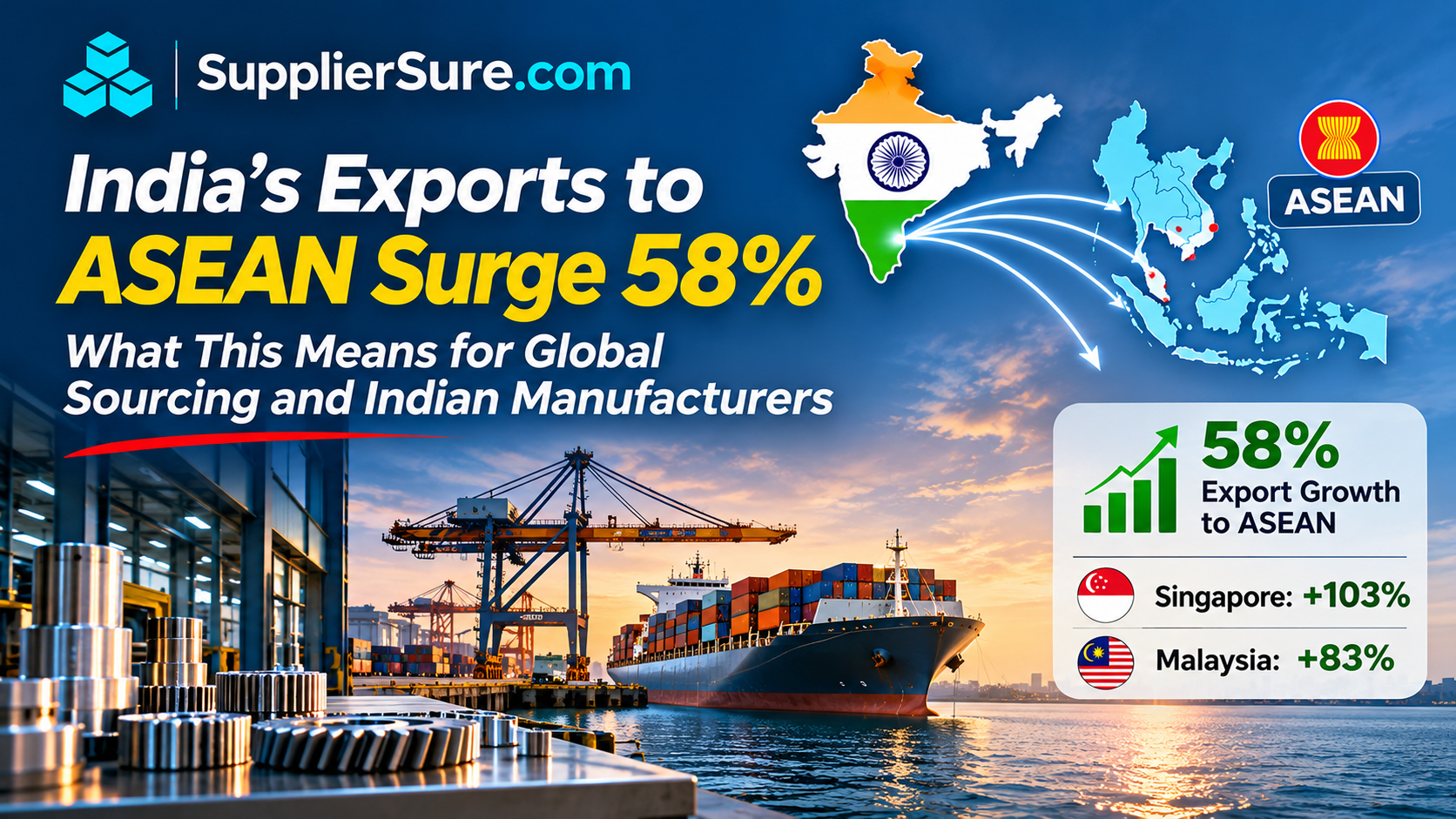
India's exports to ASEAN increased 58% to US$28.06 billion during April–September 2026, compared with US$17.75 billion in the corresponding period of the previous financial year. Singapore and Malaysia were major contributors to this expansion, with exports increasing 103% and 83%, respectively.
For international procurement teams, this growth highlights expanding commercial connections between Indian manufacturers and Southeast Asian markets. It also creates an opportunity to examine India as a sourcing destination for businesses looking to diversify their supplier networks.
Key Takeaways
- India's exports to ASEAN reached US$28.06 billion during April–September 2026, registering 58% growth.
- Exports to Singapore increased 103% to US$11.07 billion.
- Exports to Malaysia grew 83% to US$5.58 billion.
- India's exports to Vietnam and Indonesia increased 36% each.
- Exports to the European Union grew 5%, reaching US$38.79 billion.
- The expansion creates opportunities for Indian exporters to explore additional regional markets.
- International buyers should evaluate suppliers based on product competitiveness, compliance, capacity and logistics rather than aggregate export growth alone.
1. India's ASEAN trade story is becoming increasingly significant
India's relationship with Southeast Asian markets is receiving renewed commercial attention.
According to a Ministry of Commerce and Industry backgrounder published on 18 November 2026, India's exports to ASEAN reached US$28.06 billion during April–September FY2026–27, compared with US$17.75 billion during the same period last year.
That represents a 58% increase.
The expansion is particularly interesting because it is not restricted to a single destination.
Several important Southeast Asian economies recorded substantial increases in imports from India.
| Export destination | April–September 2025–26 | April–September 2026–27 | Growth |
|---|---|---|---|
| Singapore | US$5.45B | US$11.07B | 103% |
| Malaysia | US$3.05B | US$5.58B | 83% |
| Vietnam | US$2.82B* | US$3.83B | 36% |
| Indonesia | US$2.19B* | US$2.98B | 36% |
Previous-period values for Vietnam and Indonesia are approximate, calculated from the reported growth rates.
Source: Ministry of Commerce and Industry, Government of India, 18 November 2026.
This is an important development for businesses involved in international sourcing, distribution and manufacturing.
However, the more interesting question is not simply how much India exported.
It is what this geographical expansion could mean for the future of Indian manufacturing.
2. Singapore and Malaysia are emerging as important trade gateways
Two markets stand out in the latest numbers.
Singapore: A strategic commercial gateway
India's exports to Singapore increased from US$5.45 billion to US$11.07 billion.
This is more than a doubling of export value.
Singapore is an important regional commercial, financial and logistics hub. Its role in international trade extends beyond domestic consumption.
For Indian exporters, Singapore can offer access to:
- Regional distribution networks.
- International trading companies.
- Industrial and technology buyers.
- Regional procurement operations.
- Multinational businesses operating across Southeast Asia.
For manufacturers, the opportunity is not necessarily limited to selling directly to Singaporean consumers.
It may also involve supplying businesses that use Singapore as a regional distribution or procurement base.
Nevertheless, exporters must distinguish between goods imported for domestic consumption and goods subsequently re-exported.
Malaysia: A growing industrial trade relationship
Exports to Malaysia increased 83%, reaching US$5.58 billion.
Malaysia has an established industrial ecosystem spanning:
- Electrical and electronics manufacturing.
- Automotive components.
- Chemicals and petrochemicals.
- Industrial machinery.
- Medical devices.
- Rubber and related products.
The expansion in bilateral trade creates an opportunity for Indian manufacturers to explore complementary supplier relationships.
For example, Indian engineering companies could investigate opportunities to supply industrial components, fabricated products and specialised manufacturing inputs to Malaysian businesses.
These are potential areas for commercial investigation, not evidence that demand has increased in every product category.
3. What does this mean for Indian manufacturers?
Aggregate export growth is encouraging, but individual manufacturers need to translate it into actionable commercial opportunities.
A manufacturer in India cannot assume that a rising national export figure will automatically generate new orders.
The real opportunity lies in identifying the products, buyers and markets where Indian manufacturing offers a competitive advantage.
Three areas deserve attention.
A. Engineering and industrial components
Southeast Asia has a significant industrial manufacturing base.
Indian manufacturers producing:
- Precision-machined components.
- Industrial fasteners.
- Castings and forgings.
- Fabricated metal products.
- Industrial pumps and valves.
- Automotive components.
can investigate opportunities to become alternative suppliers for regional manufacturers.
The commercial proposition should focus on technical capability, consistent quality, competitive pricing and dependable delivery.
B. Chemicals and industrial inputs
India has an established chemical manufacturing ecosystem.
Speciality chemicals, industrial intermediates and selected chemical inputs may offer opportunities in regional markets.
However, exporters must carefully evaluate destination-country registration requirements, chemical regulations, product documentation and transport restrictions.
C. Textiles and manufactured consumer goods
India's textile and consumer manufacturing capabilities also provide potential opportunities in Southeast Asia.
Manufacturers should investigate:
- Technical textiles.
- Home textiles.
- Garments.
- Processed consumer goods.
- Selected leather and footwear products.
Product-level demand research is essential before committing to export expansion.
4. Why international procurement teams should pay attention
For an international procurement manager, export growth is an indicator worth monitoring.
It can reveal changing trade relationships, emerging commercial corridors and potential supplier ecosystems.
However, it should not be mistaken for proof that every Indian manufacturer has become more competitive.
A procurement team evaluating India should investigate five questions.
1. Is the product commercially competitive?
Compare the complete landed cost, including manufacturing, freight, insurance, duties and other applicable charges.
2. Can the supplier meet technical specifications?
Evaluate manufacturing processes, tolerances, testing capabilities and quality management.
3. Is production capacity available?
A supplier's installed capacity is not necessarily its available capacity.
4. Can the supplier meet destination-market requirements?
Assess applicable certifications, regulatory obligations, documentation and traceability.
5. Is the supplier independently verifiable?
Validate the legal entity, manufacturing location, banking details and operational credentials.
For international buyers, the objective should be to identify suppliers capable of meeting their actual procurement requirements rather than simply sourcing from a country experiencing export growth.
5. India's wider export diversification is worth watching
The ASEAN development is part of a broader expansion across India's international trade relationships.
The same Ministry of Commerce and Industry report highlighted growth across several other markets.
| Market | Export growth |
|---|---|
| ASEAN | 58% |
| SAFTA partners | 22% |
| Japan | 40% |
| South Korea | 24% |
| European Union | 5% |
| Australia | 11% |
| United Kingdom | 7% |
| Oman | 47% |
Source: Ministry of Commerce and Industry, April–September FY2026–27.
These figures suggest that India's export expansion is reaching multiple geographical regions.
For manufacturers, this raises an important strategic consideration.
Instead of depending on a small number of overseas customers or destinations, businesses can investigate opportunities across multiple markets.
For buyers, a broader export footprint can make India an increasingly relevant country to include in supplier diversification exercises.
However, market growth alone does not establish supplier reliability or product-level competitiveness.
6. The opportunity comes with operational challenges
Expanding into a new export market requires more than identifying a buyer.
Indian manufacturers need to prepare for the operational requirements of international trade.
Regulatory compliance
Product regulations differ across destinations.
Manufacturers must understand applicable product standards, chemical restrictions, labelling requirements, testing obligations and import documentation.
Logistics and delivery
Shipping schedules, port connectivity, container availability and transit times influence the final landed cost.
A competitive factory quotation can become commercially unattractive when logistics costs are not properly calculated.
Quality consistency
International customers often expect repeatable quality across multiple shipments.
Manufacturers need documented inspection processes, traceability and corrective-action procedures.
Payment and counterparty risk
New international buyers should be evaluated for commercial credibility, payment history and contractual reliability.
Exporters should not treat every overseas enquiry as a qualified business opportunity.
Working capital
Export growth can increase working-capital requirements.
Manufacturers may need to finance raw materials, production, packaging and logistics before receiving final payment.
Businesses should carefully evaluate payment terms, credit exposure and currency risks.
7. What should Indian exporters do next?
Manufacturers looking to capitalise on expanding trade relationships should take a structured approach.
Step 1: Identify suitable markets
Shortlist destinations based on product demand, regulatory requirements and competitive positioning.
Step 2: Map potential buyers
Identify importers, distributors, industrial procurement teams and manufacturers that use the relevant products.
Step 3: Prepare export documentation
Ensure that company registrations, IEC details, product specifications, certifications and commercial documents are ready.
Step 4: Build a competitive export quotation
Calculate manufacturing cost, packaging, freight, insurance, duties and payment-related expenses.
Step 5: Establish buyer credibility
Verify the buyer's legal identity, commercial history and payment capability.
Step 6: Demonstrate manufacturing capability
Provide technical documentation, product samples, quality records and realistic production schedules.
Export expansion should be approached as a repeatable business-development process rather than a series of disconnected enquiries.
8. The emerging role of AI in cross-border sourcing
As trade relationships expand, the volume of information required to make procurement decisions also increases.
An international buyer looking for an Indian supplier may need to evaluate hundreds of potential businesses.
Traditionally, this process involves:
- Searching multiple B2B directories.
- Identifying manufacturers.
- Collecting company documents.
- Comparing quotations.
- Checking technical capabilities.
- Verifying supplier credentials.
- Coordinating RFQs.
This creates considerable manual work.
AI-powered procurement systems can help streamline several stages.
An intelligent sourcing workflow could:
- Interpret product specifications.
- Identify relevant Indian manufacturing clusters.
- Generate structured RFQs.
- Shortlist potentially suitable suppliers.
- Organise supplier documentation.
- Flag inconsistencies in available records.
- Compare quotations and commercial terms.
The important distinction is that AI-assisted screening does not replace physical factory inspections or independent verification.
Technology can make supplier evaluation more efficient, but procurement decisions still require evidence.
This is the opportunity SupplierSure is working towards: bringing supplier discovery, procurement intelligence and AI-assisted sourcing workflows into a more structured environment.
Frequently Asked Questions
1. How much did India's exports to ASEAN grow in 2026?
India's exports to ASEAN increased 58% to US$28.06 billion during April–September FY2026–27, compared with US$17.75 billion in the corresponding period of the previous year.
2. Which ASEAN country recorded the highest growth in imports from India?
Among the major ASEAN destinations highlighted in the November 2026 government report, Singapore recorded the highest growth, with Indian exports increasing 103% to US$11.07 billion.
3. How much did India's exports to Malaysia increase?
India's exports to Malaysia increased 83%, reaching US$5.58 billion during April–September FY2026–27.
4. Why is ASEAN important for Indian exporters?
ASEAN offers access to a diverse regional market comprising manufacturing economies, trading hubs and industrial buyers. Its geographical proximity and existing trade arrangements make it an important region for Indian exporters to investigate.
5. Which Indian manufacturing sectors could benefit from stronger ASEAN trade?
Potential areas include engineering components, automotive parts, chemicals, industrial machinery, textiles, electrical equipment and selected consumer products. Actual opportunities depend on destination-market demand and product competitiveness.
6. Does higher export growth mean Indian products are becoming more competitive?
Not necessarily. Higher export values may reflect several factors, including demand, pricing, product mix and trade flows. Product-level analysis is necessary to establish whether competitiveness has improved.
7. How can an international buyer find Indian manufacturers?
Buyers can use industry associations, trade exhibitions, B2B sourcing platforms, government resources and specialised procurement services. Supplier credentials, factory capabilities and product compliance should be independently evaluated.
8. What should Indian manufacturers do to enter ASEAN markets?
Manufacturers should identify suitable destinations, research buyer demand, understand import regulations, prepare export documentation, calculate landed costs and establish credible international distribution or buyer relationships.
Final Thoughts
India's 58% export growth to ASEAN is an encouraging development.
But the real significance lies beyond the headline number.
It reflects expanding commercial connections between India and Southeast Asia and creates an opportunity for Indian manufacturers to investigate new international markets.
For exporters, the next challenge is converting market opportunities into qualified buyers and sustainable orders.
For international procurement teams, it is about identifying manufacturers who can offer the right combination of price, quality, capacity, compliance and reliability.
Trade growth creates possibilities. Competitive manufacturers convert those possibilities into business.
And procurement intelligence helps buyers identify the right partners.
About SupplierSure
SupplierSure is an AI-powered sourcing terminal focused on connecting international procurement demand with India's manufacturing ecosystem.
Our objective is to make supplier discovery, procurement intelligence and sourcing workflows more structured, transparent and accessible.
Explore SupplierSure: https://suppliersure.com/
Sources
Ministry of Commerce and Industry, Government of India — From ASEAN to Europe: India's Exports Gain Momentum Across FTA Partners and Beyond, published 18 November 2026. https://www.pib.gov.in/PressReleasePage.aspx?PRID=2337897&lang=1®=6
Department of Commerce, Government of India. https://www.commerce.gov.in/
ASEAN — Association of Southeast Asian Nations. https://asean.org/
Ready to source from India?
SupplierSure connects international buyers with GST-verified Indian manufacturers — from spec and RFQ to supplier matching, quality checks and shipment. Tell us what you need and our sourcing team will shortlist the right suppliers.
Or email us at: info@kalantic.com