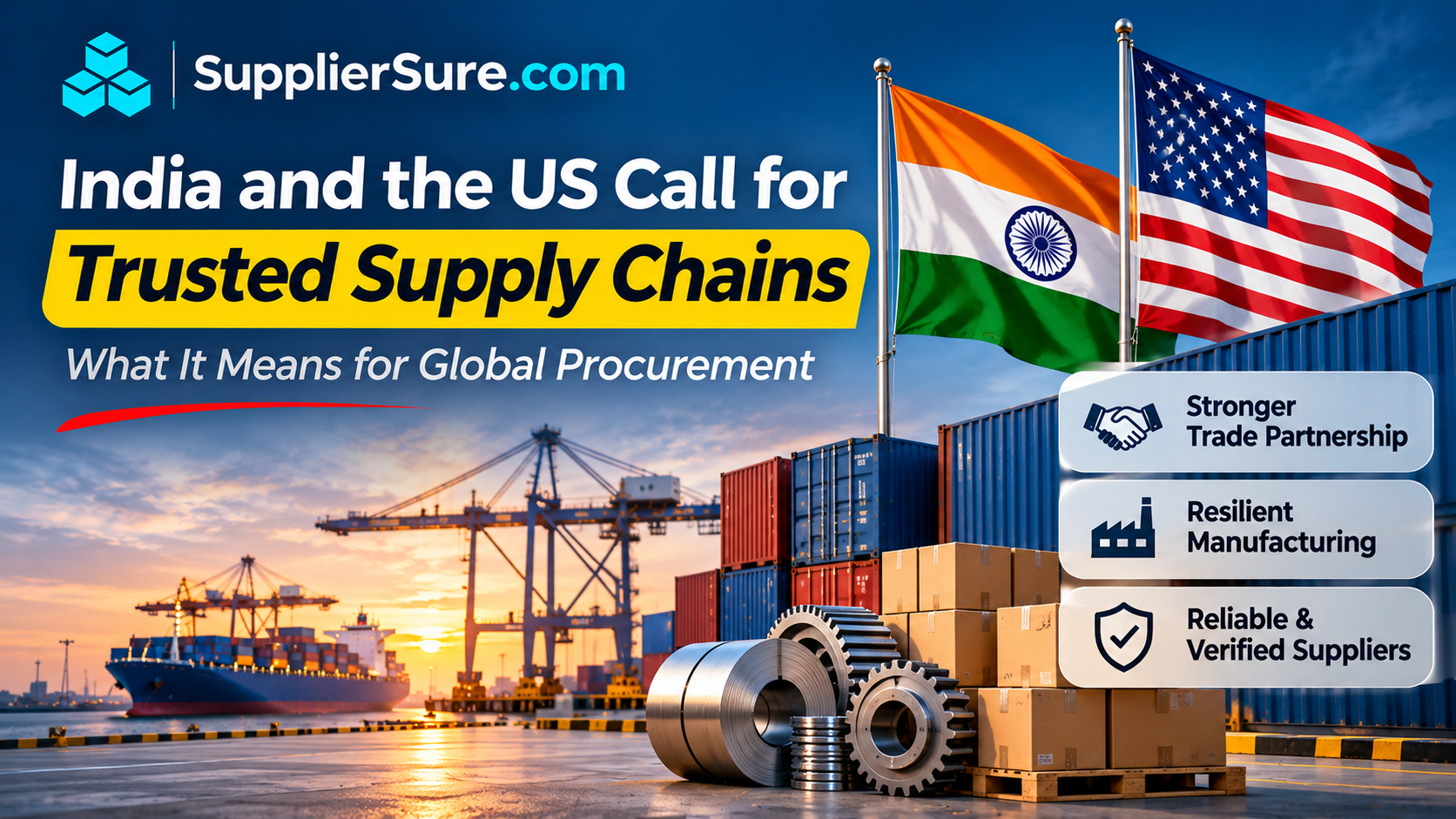
India and the United States are looking to deepen cooperation around resilient and trusted supply chains. Speaking at the 23rd Indo-US Economic Summit on 19 November 2026, India's Commerce and Industry Minister Piyush Goyal said that global businesses need supply-chain partners who share common principles, respect the rule of law and honour contractual commitments.
For international procurement teams, this highlights a growing shift in sourcing priorities. Competitive pricing and production capacity remain important, but buyers must also evaluate supplier credibility, compliance, operational resilience and the ability to deliver consistently.
The implication for Indian manufacturers is equally significant: access to international markets increasingly depends on demonstrating that a factory is not merely capable of producing goods, but also capable of being a dependable long-term business partner.
Key Takeaways
- India and the US are emphasising trusted and resilient supply-chain partnerships amid geopolitical uncertainty.
- Supplier reliability involves more than product quality or quoted prices.
- International buyers need stronger vendor due diligence, documentation and ongoing performance monitoring.
- Indian manufacturers can strengthen their export readiness by improving traceability, compliance and operational transparency.
- Technology, including AI-enabled procurement tools, can help buyers assess supplier risk and manage sourcing decisions more systematically.
1. The News: A Stronger Focus on Trusted Trade Partnerships
On 19 November 2026, Commerce and Industry Minister Piyush Goyal called for India and the United States to work together to build resilient and trusted supply chains.
His remarks came at the 23rd Indo-US Economic Summit, organised by the Indo-American Chamber of Commerce.
The minister highlighted the complementary strengths of the two economies: the United States brings capital, technology and innovation, while India offers manufacturing scale, talent and competitiveness.
He also pointed to the importance of cooperation in advanced manufacturing, artificial intelligence, healthcare and pharmaceuticals.
The comments come against a backdrop of geopolitical uncertainty, disruptions associated with conflicts in West Asia and Ukraine, and continuing negotiations over an India-US bilateral trade agreement.
The message is relevant beyond the two countries. It reflects a wider concern among businesses that supply chains must be dependable when international trade conditions become unpredictable.
India has also set an ambitious export target of US$1 trillion for the current financial year. According to the minister's remarks reported at the summit, the country recorded US$863 billion in exports in the previous financial year and approximately US$480 billion during April–September of the current year.
These figures demonstrate the scale of India's export ambitions. However, converting that ambition into durable international business relationships requires more than expanding production capacity.
It requires trust.
2. What Does a Trusted Supply Chain Actually Mean?
The phrase "trusted supply chain" can sound like a diplomatic expression. For a procurement manager, however, it has very practical implications.
A trusted supply chain is one in which buyers can establish confidence in the businesses, facilities, processes and commercial commitments behind every purchase.
It involves several dimensions.
A. Verified supplier identity
The buyer should know which legal entity they are dealing with.
This includes checking company registration, legal status, registered addresses, ownership information where available, and the authority of the individuals representing the business.
A trading company claiming to own a factory, or an intermediary presenting another company's manufacturing credentials as its own, can create significant procurement risk.
B. Actual manufacturing capability
A supplier's catalogue or website does not establish production capability.
Buyers need to understand:
- Whether the supplier owns or operates the claimed facility.
- What machinery and production processes are available.
- Whether the factory has the capacity to meet the order volume.
- Whether critical processes are outsourced.
- Whether production capacity is currently committed to other customers.
- Whether the supplier has experience manufacturing the required product.
A factory's stated capacity and its available capacity are not necessarily the same.
C. Quality management and consistency
A sample may be excellent while the eventual bulk order is inconsistent.
Procurement teams should examine quality-control procedures, inspection records, testing capabilities, defect management and corrective-action processes.
Certifications can support an assessment, but buyers should verify their validity, scope, issuing organisation and relevance to the actual manufacturing facility.
D. Compliance and traceability
International sourcing increasingly requires buyers to understand where products originate, how they are manufactured and whether relevant regulatory requirements are being met.
Depending on the product and destination market, this can include:
- Product safety and technical standards.
- Material and chemical compliance.
- Environmental requirements.
- Labour and workplace standards.
- Origin documentation.
- Batch-level traceability.
- Industry-specific certifications.
A generic statement that a supplier is "export compliant" is not sufficient evidence.
E. Commercial and contractual reliability
A dependable supplier should be able to clearly communicate:
- Pricing and quotation validity.
- Production timelines.
- Payment terms.
- Delivery responsibilities.
- Packaging and inspection requirements.
- Warranty and rejection procedures.
- Remedies for delays or non-conformance.
A low quotation can become an expensive procurement decision if the supplier cannot honour the agreed terms.
3. Why Global Buyers Are Rethinking Supplier Selection
For years, procurement decisions in many categories were heavily influenced by price, production capacity and delivery timelines.
Those factors remain important. But a sourcing decision based primarily on the lowest quotation can expose a business to risks that are difficult to quantify at the beginning of a transaction.
Consider a buyer sourcing industrial components from a new overseas manufacturer.
The quoted price may be 12% lower than the incumbent supplier. However:
- The factory's actual production capacity has not been established.
- The quality certificate belongs to a different legal entity.
- The supplier outsources a critical production process.
- The proposed delivery timeline excludes inspection and shipping contingencies.
- The payment terms provide little protection if production fails.
The apparent saving may disappear through rework, delayed deliveries, emergency procurement or rejected shipments.
This is why procurement teams increasingly need to evaluate total sourcing risk rather than unit price alone.
A more useful procurement question is not simply:
"Who can supply this product at the lowest price?"
It is:
"Which supplier can meet our technical, commercial, regulatory and operational requirements with the lowest acceptable level of risk?"
4. What This Means for Indian Manufacturers
The growing emphasis on trusted supply chains creates an opportunity for Indian manufacturers, particularly those looking to establish relationships with international buyers.
However, export readiness should not be confused with export ambition.
A manufacturer may have excellent production capabilities but still struggle to win international contracts because its documentation, communication or verification processes are inadequate.
Indian manufacturers looking to work with international procurement teams should focus on five areas.
1. Build a verifiable business profile
Maintain consistent company information across registration documents, websites, catalogues, quotations and export documentation.
Clearly distinguish between owned manufacturing facilities, leased facilities, partner factories and outsourced processes.
2. Document manufacturing capability
Provide credible information about machinery, production capacity, quality systems, product categories and previous export experience.
Where possible, support claims with dated photographs, inspection reports, process documentation and independently verifiable records.
3. Make compliance evidence accessible
Maintain updated certifications, test reports, product specifications and relevant regulatory documentation.
Do not rely on certificates that are expired, outside their stated scope or issued to another legal entity.
4. Improve commercial discipline
Respond to RFQs with complete quotations. Clearly specify product specifications, minimum order quantities, lead times, payment terms and delivery conditions.
International buyers value suppliers who communicate constraints honestly rather than promise unrealistic delivery schedules.
5. Treat verification as a competitive advantage
A supplier that makes it easy for a buyer to validate its credentials reduces friction in the procurement process.
Transparency can become a differentiator, particularly when competing against suppliers with similar pricing and production capabilities.
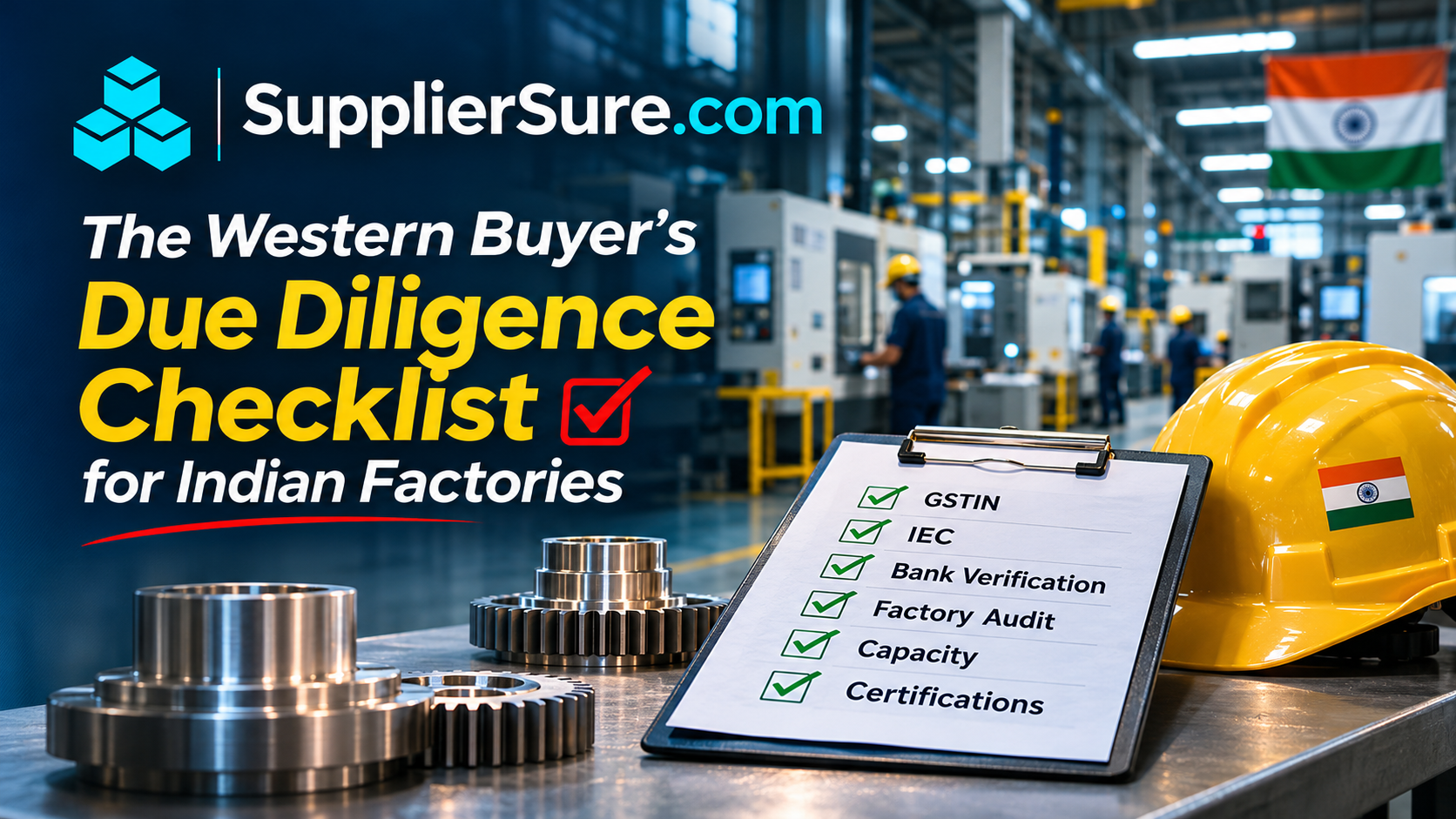
5. A Practical Trusted-Supplier Checklist for International Buyers
Before onboarding a new Indian supplier, procurement teams can use the following framework.
| Assessment area | What buyers should verify |
|---|---|
| Legal identity | Registration, legal entity and business address |
| Ownership and representation | Authorised representatives and disclosed intermediaries |
| Factory capability | Facility existence, machinery and production processes |
| Capacity | Actual available capacity and production commitments |
| Quality | Quality-control procedures, testing and inspection records |
| Certifications | Validity, scope and issuing organisation |
| Compliance | Product-specific and destination-market requirements |
| Commercial terms | Pricing, payment, delivery and rejection clauses |
| References | Verifiable customer or export references, where available |
| Risk monitoring | Changes in ownership, operations, certification or performance |
The depth of due diligence should reflect the value, criticality and risk of the purchase.
A small, non-critical purchase may require a lighter assessment. A strategic component, regulated product or long-term manufacturing contract warrants significantly deeper verification.
6. Can AI Make Supplier Verification More Effective?
Traditional supplier discovery often begins with directories, trade fairs, referrals and online searches.
These channels can help identify potential vendors. But discovery and verification are two different activities.
AI-enabled procurement systems can help organise the evaluation process by:
- Consolidating supplier information from multiple sources.
- Identifying inconsistencies in company profiles.
- Structuring RFQ comparisons.
- Highlighting missing compliance documents.
- Categorising suppliers by product and manufacturing capability.
- Tracking supplier performance and changes in risk indicators.
- Helping procurement teams prioritise suppliers for further investigation.
However, AI should support due diligence, not replace it.
A system that finds a company registration record cannot independently establish that a factory is operational. A document uploaded by a supplier does not automatically prove that the document is authentic or applicable.
Physical inspections, independent verification, testing and contractual safeguards remain important where the risk warrants them.
The strongest procurement model combines technology with evidence-based human verification.
7. The Bigger Opportunity: Moving from Supplier Discovery to Supplier Intelligence
The international sourcing market has no shortage of supplier listings.
The real challenge is determining which businesses are suitable for a particular procurement requirement.
A directory can tell a buyer that a manufacturer exists. A structured supplier-intelligence process should help answer much more:
- Does the company manufacture the product?
- Is the facility capable of meeting the required specification?
- Are the certifications relevant and current?
- Can the supplier meet the required volume?
- Are there material commercial or operational risks?
- What evidence is still missing before onboarding?
This distinction matters for both sides of the transaction.
Buyers need better information before committing money and production schedules. Manufacturers need credible ways to demonstrate their capabilities and reach serious buyers.
SupplierSure is built around this broader procurement challenge: helping businesses move beyond basic supplier discovery towards more informed sourcing and supplier evaluation.
Frequently Asked Questions
1. What are trusted supply chains?
Trusted supply chains are networks of suppliers, manufacturers and logistics partners whose identities, capabilities, compliance and contractual commitments can be assessed with reasonable confidence.
2. Why are India and the US discussing trusted supply chains?
On 19 November 2026, Commerce Minister Piyush Goyal called for stronger India-US cooperation to build resilient and trusted supply chains amid geopolitical uncertainty and disruptions to international trade.
3. Does a supplier certification guarantee that a factory is reliable?
No. A certification provides evidence of compliance with a defined standard or scope. Buyers should independently verify its validity, issuing organisation, scope and applicability to the actual facility and product.
4. How can international buyers verify Indian manufacturers?
Buyers can combine legal-entity checks, factory verification, production-capability assessments, certification validation, quality-system reviews, customer references and independent inspections.
5. What is the difference between supplier discovery and supplier verification?
Supplier discovery identifies potential vendors. Supplier verification evaluates whether those vendors are genuine, capable and suitable for a specific procurement requirement.
6. How does geopolitical uncertainty affect procurement?
Geopolitical disruptions can affect shipping routes, freight costs, energy prices, availability of raw materials, trade restrictions and delivery schedules. Buyers therefore need to evaluate supplier concentration, alternative sourcing options and supply-chain resilience.
7. Can AI verify suppliers?
AI can help organise information, identify inconsistencies, compare documents and flag missing evidence. It cannot independently establish that a factory is operational or guarantee the authenticity of every supplier claim. Independent verification remains necessary.
8. What should Indian manufacturers do to become export-ready?
Manufacturers should maintain verifiable business records, document production capability, strengthen quality systems, keep compliance documentation current and communicate commercial terms transparently.
Final Thoughts
The conversation around global sourcing is evolving.
For international buyers, the question is no longer only where a product can be manufactured cheaply. It is whether the supplier can be trusted to deliver the right product, at the agreed quality, within the agreed timeline and under transparent commercial conditions.
For Indian manufacturers, this creates an opportunity to compete not only on cost and capacity, but also on credibility.
India's role in global manufacturing will depend on its ability to build lasting business relationships. And those relationships begin with trust that can be demonstrated, not merely promised.
About SupplierSure
SupplierSure is an AI-powered sourcing and supplier-intelligence platform focused on helping international buyers discover, assess and connect with Indian manufacturers.
From supplier discovery and RFQ workflows to vendor evaluation and procurement intelligence, SupplierSure aims to make sourcing from India more transparent, structured and dependable.
Explore SupplierSure to make your next sourcing decision with better information.
Sources
Moneycontrol — "India, US must build trusted supply chains amid global uncertainty: Piyush Goyal" (19 November 2026). https://www.moneycontrol.com/news/business/india-us-must-build-trusted-supply-chains-amid-global-uncertainty-piyush-goyal-14085119.html
Press Information Bureau, Government of India — Ministry of Commerce and Industry updates. https://www.pib.gov.in/
Ready to source from India?
SupplierSure connects international buyers with GST-verified Indian manufacturers — from spec and RFQ to supplier matching, quality checks and shipment. Tell us what you need and our sourcing team will shortlist the right suppliers.
Or email us at: info@kalantic.com