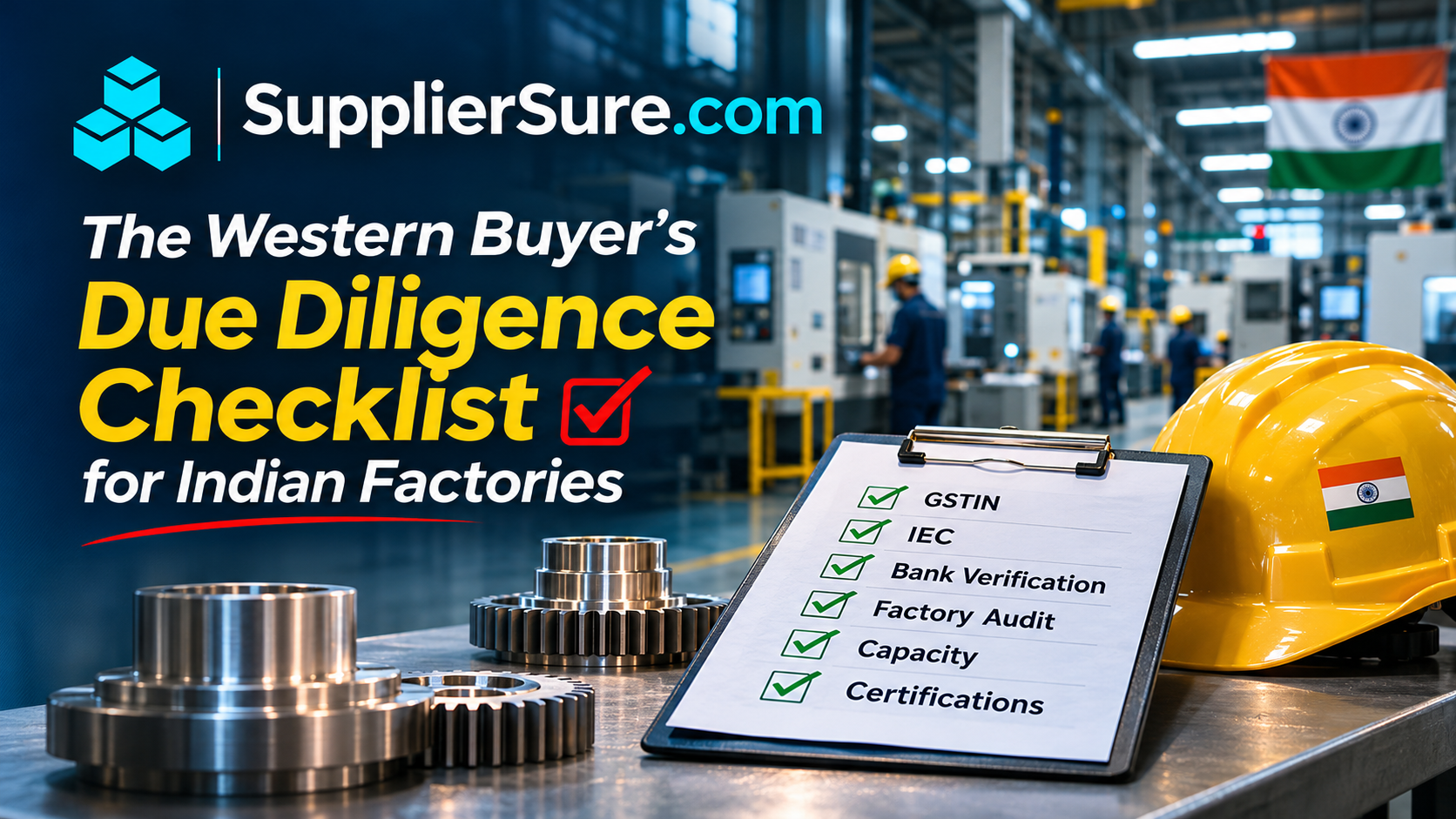
To verify an Indian manufacturer before placing an international purchase order, buyers should independently validate the company's legal identity, GST registration, Importer Exporter Code (IEC), banking details, physical manufacturing facility, production capacity and quality certifications.
Government registries can establish important parts of a supplier's identity, but an independent factory assessment is necessary to establish whether the supplier can actually manufacture and deliver the required product.
The most important principle is to verify the legal entity, verify the physical operation, and verify the transaction independently before transferring an advance payment.
Key Takeaways
- GSTIN verification: Use India's official GST portal to confirm the supplier's registered legal name, business status and principal place of business.
- Company verification: Check incorporation details, company status and directors through the Ministry of Corporate Affairs (MCA).
- Export credentials: Verify the supplier's IEC through the Directorate General of Foreign Trade (DGFT).
- Bank verification: Independently confirm that the beneficiary account corresponds to the contracted supplier.
- Factory verification: Establish whether the supplier actually owns or operates the manufacturing facility it claims to represent.
- Production capacity: Validate machinery, workforce, production volumes, utilisation and existing order commitments.
- Quality assurance: Verify certifications against the issuing organisation, applicable facility and product scope.
- Payment protection: Avoid substantial advance payments until legal, operational, banking and contractual checks are complete.
1. Why supplier verification in India requires more than a GST certificate
India has a diverse manufacturing ecosystem spanning textiles, engineering, automotive components, chemicals, pharmaceuticals, ceramics, leather goods and consumer products.
For international procurement teams, this presents an opportunity to diversify sourcing beyond established manufacturing markets.
However, supplier discovery and supplier verification are two fundamentally different activities.
A business appearing in a B2B directory may be:
- An actual manufacturer operating its own factory.
- A contract manufacturer outsourcing production.
- A merchant exporter purchasing from multiple factories.
- A trading intermediary representing several manufacturers.
- A recently incorporated business with limited operating history.
None of these business models is inherently illegitimate. The risk arises when the supplier's actual role is misrepresented.
For example, an international buyer looking for a precision-machined component may receive a quotation from a trading company that claims to operate a CNC manufacturing facility.
The trading company may be perfectly capable of fulfilling the order through subcontractors. However, the buyer needs to know this before signing a contract.
This distinction affects:
- Production accountability.
- Quality control.
- Intellectual property protection.
- Delivery commitments.
- Traceability.
- Warranty obligations.
- Commercial risk.
A supplier's documentation should therefore be treated as the starting point of due diligence, not its conclusion.
2. Verify the supplier's legal identity
The first step is establishing exactly which legal entity you are contracting with.
Request the following documents:
| Document | What it establishes |
|---|---|
| Certificate of Incorporation | Legal incorporation of a company |
| PAN | Tax identity |
| GSTIN | Goods and Services Tax registration |
| IEC | Importer Exporter Code, where applicable |
| Registered address proof | Official business address |
| Director/owner details | Relevant ownership and management information |
| Cancelled cheque or bank letter | Banking information for beneficiary verification |
The documents should consistently identify the same business.
A quotation from one company, an invoice from another and a bank account belonging to an unrelated third party should trigger additional investigation.
2.1 Verify the GSTIN
The GST portal allows buyers to search for registered taxpayers using their GSTIN.
Official resource: https://services.gst.gov.in/services/quicklinks/searchtxp
The publicly accessible taxpayer information can include:
- Legal name of the business.
- Trade name.
- GST registration status.
- Effective registration date.
- Constitution of business.
- Principal place of business.
- Cancellation information, where applicable.
- Available return-filing information.
What should international buyers check?
- Obtain the supplier's GSTIN.
- Enter it into the official GST taxpayer search.
- Compare the legal name with the quotation and company documents.
- Check whether the registration is active.
- Compare the principal business address with the supplier's declared operating location.
- Investigate any discrepancies in business names or addresses.
The GST portal provides a valuable identity check, but GST registration does not establish that the registered entity owns a manufacturing facility.
Source: https://tutorial.gst.gov.in/userguide/taxpayersdashboard/Search_Taxpayer_manual.htm
2.2 Verify the company through MCA
For incorporated companies and LLPs, the MCA database provides another layer of verification.
Official resource: https://www.mcacdm.nic.in/company-master-details
Check:
- Company or LLP name.
- Corporate Identification Number (CIN) or LLPIN.
- Incorporation date.
- Current company status.
- Registered office.
- Available director and management information.
An important distinction: India's manufacturing ecosystem also includes sole proprietorships and partnerships. These businesses may not appear as incorporated companies in MCA records.
Therefore, the absence of an MCA record is not automatically evidence of fraud.
Procurement recommendation: Match the legal structure declared by the supplier with the relevant government registry. Do not expect every legitimate manufacturer to have a CIN.
3. Verify the Importer Exporter Code (IEC)
If the supplier claims to have an export track record, ask for its IEC.
The IEC is a 10-character identification number issued by DGFT for import and export activities, subject to applicable exemptions and requirements.
Official resource: https://www.dgft.gov.in/
The DGFT portal provides services for viewing IEC-related details. These include access to information concerning IEC status and the Denied Entity List (DEL).
Buyers should:
- Request the supplier's IEC.
- Obtain the exact legal business name associated with it.
- Use DGFT's official IEC-related services to check the record.
- Review the available IEC status.
- Investigate discrepancies between the IEC holder and the contracting entity.
An additional check is available through India's Customs platform.
Official resource: https://www.icegate.gov.in/
ICEGATE provides IEC-related status enquiries, including status descriptions such as normal, suspended, cancelled and blacklisted.
Important: An IEC is evidence of an export-related registration, not proof of export performance. A company holding an IEC may never have completed a commercial export shipment.
Source: https://content.dgft.gov.in/Website/IEC_Manual_V4.0.pdf
4. Verify the supplier's bank account before paying an advance
Payment diversion is a significant procurement risk.
Consider a scenario:
An overseas buyer negotiates with an Indian manufacturer, receives a quotation and agrees to a 30% advance payment.
Shortly before payment, the supplier sends revised banking instructions.
The new beneficiary is an individual or an unrelated company.
This should immediately trigger additional verification.
Documents to request
- Cancelled cheque bearing the beneficiary's account details.
- Bank-issued account confirmation or equivalent evidence.
- Legal name of the account holder.
- Bank name and branch.
- IFSC code.
- Written explanation if the beneficiary differs from the contracting entity.
Use beneficiary name lookup
The Reserve Bank of India issued instructions introducing beneficiary bank account name lookup for RTGS and NEFT transfers.
The facility allows remitters to retrieve the beneficiary's account name using the account number and IFSC through participating banks' internet banking, mobile banking or branch channels.
Official resource: https://www.rbi.org.in/Scripts/BS_ViewMasDirections.aspx?id=12759
Buyers should use the facility where available and compare the displayed beneficiary name with the contracted legal entity.
If there is a mismatch, obtain independent confirmation through previously established supplier contact details.
A practical banking control:
Never accept revised bank details solely through an email requesting urgent payment.
Instead:
- Contact the supplier using a previously verified telephone number.
- Speak to an authorised finance representative.
- Confirm the revised beneficiary and reason for the change.
- Obtain supporting bank documentation.
- Record approval internally before releasing funds.
A bank account name match is an important control, but it does not independently establish that the account is authorised to receive the contractual payment.
5. Confirm that the supplier actually operates a factory
This is arguably the most important operational verification exercise.
A company can have valid registration documents, a website, a professional sales team and an impressive product catalogue without operating the manufacturing facility it claims to represent.
There are three common supplier models:
| Supplier type | Operating model | Buyer's consideration |
|---|---|---|
| Direct manufacturer | Owns or operates production facilities | Verify actual capacity and control |
| Contract manufacturer | Outsources some or all production | Verify subcontractors and accountability |
| Merchant exporter | Sources products from third-party factories | Verify actual manufacturing partners |
All three models can serve legitimate procurement needs.
The buyer's objective is to understand which model is being offered.
5.1 Conduct a physical factory inspection
For significant purchase orders, arrange an independent factory inspection.
A physical audit should cover:
Facility identity
- Does the factory address match the supplier's declaration?
- Is the facility permanently operational?
- Is the business name or operating entity identifiable?
- Does the facility manufacture the products being quoted?
Manufacturing infrastructure
- What machinery is installed?
- Is the machinery owned, leased or subcontracted?
- Is the equipment appropriate for the required product?
- Are maintenance and calibration records available?
Workforce
- How many employees work at the facility?
- What technical skills are available?
- Is there a dedicated quality team?
- Are production supervisors identifiable?
Production environment
- Is the facility adequately organised?
- Are raw materials properly stored?
- Are finished goods traceable?
- Are safety and housekeeping practices maintained?
A factory visit should not be reduced to a photographic exercise.
The objective is to establish whether the facility has the infrastructure, processes and management capability required for the proposed order.
5.2 Are video factory audits reliable?
Video audits are useful, particularly during initial supplier screening.
However, they have limitations.
A supplier-controlled video call may show:
- Borrowed machinery.
- A temporary production setup.
- Another company's factory.
- A facility that is not operationally controlled by the supplier.
A video inspection should therefore include live verification.
Ask the supplier to:
- Show the exterior and surrounding location.
- Walk from the factory entrance to the production floor.
- Demonstrate relevant machinery in operation.
- Show current production work.
- Display identifiable equipment and production records.
- Demonstrate the quality-control process.
Where practical, request a live location-specific task during the audit.
For larger orders, use an independent third-party inspection agency rather than relying exclusively on supplier-arranged video footage.
6. Validate actual manufacturing capacity
A supplier may own the right machinery but still lack sufficient capacity to fulfil your order.
Consider a buyer sourcing 20,000 precision-machined components per month.
The supplier claims to have 15 CNC machines.
That number alone tells you very little.
The buyer needs to understand machine availability, cycle time, shifts, utilisation, rejection rates and existing commitments.
Questions to ask the manufacturer
| Parameter | Information required |
|---|---|
| Installed machinery | Type, quantity and specifications |
| Machine utilisation | Current operating hours and capacity usage |
| Production shifts | Number of shifts per day |
| Monthly capacity | Practical output, not theoretical maximum |
| Current orders | Existing production commitments |
| Lead time | Realistic production and dispatch schedule |
| Rejection rate | Historical production rejection levels |
| Bottlenecks | Processes limiting overall output |
Calculate practical production capacity
A simplified capacity calculation is:
Monthly Output = (Available Production Minutes / Cycle Time per Unit) × Efficiency
For example:
Assume a manufacturer has:
- 10 machines.
- 8 operating hours per day.
- 25 working days per month.
- 12 minutes per unit.
- 75% practical operating efficiency.
The estimated monthly output is:
(10 × 8 × 60 × 25 / 12) × 0.75 = 7,500 units
The facility's estimated practical output is 7,500 units per month, assuming all 10 machines can perform the same operation and the stated efficiency is realistic.
This is a simplified estimate. Actual production planning must account for tooling, setup time, product mix, maintenance, bottleneck processes and quality losses.
Procurement insight: Do not ask only how much a factory can produce. Ask how much capacity it can commit to your order after accounting for existing customers.
7. Verify quality certifications and compliance
Certifications are frequently included in supplier presentations to establish credibility.
However, a certificate should never be accepted at face value.
Request:
- ISO 9001 quality management certification, where relevant.
- ISO 14001 environmental management certification, where relevant.
- ISO 45001 occupational health and safety certification, where relevant.
- Product-specific conformity certificates.
- BIS licences where applicable.
- Customer-specific quality approvals, where relevant.
How to verify BIS certification
The Bureau of Indian Standards provides the BIS CARE application, which includes a facility to verify licence details.
Official resource: https://www.bis.gov.in/bis-apps/
Buyers should check:
- Licence number.
- Manufacturer name.
- Product category.
- Applicable Indian Standard.
- Licence validity and status.
- Whether the certification applies to the manufacturing location being presented.
BIS certification is product and scope specific. Not every Indian manufacturer or product requires BIS certification.
The BIS certification process also involves assessment of manufacturing infrastructure, process controls, quality-control capabilities and product conformity.
Source: https://www.bis.gov.in/product-certification/product-certification-faq/
What about CE, REACH and FDA compliance?
International buyers must distinguish between supplier-level certifications and product-level regulatory requirements.
| Requirement | What the buyer should establish |
|---|---|
| CE marking | Whether the product falls under applicable EU legislation and conformity assessment requirements |
| REACH | Whether relevant chemical restrictions and registration obligations are met |
| FDA requirements | Whether the specific product and activity fall within applicable US FDA requirements |
| ISO 9001 | Whether the supplier's quality management system is certified within the stated scope |
| BIS | Whether the product requires Indian certification and whether the licence is valid |
A factory holding ISO 9001 certification does not automatically mean its products comply with European or American product regulations.
The buyer should identify the applicable regulatory framework for the actual product being imported.
8. Examine the supplier's export track record
An export-ready supplier should be able to demonstrate experience with international transactions, if it claims such experience.
Request supporting evidence such as:
- Redacted commercial invoices.
- Redacted shipping bills.
- Bills of lading or airway bills.
- Certificates of origin.
- Previous export destinations.
- References from international customers.
- Evidence of repeat business.
Do not insist on unrestricted access to confidential customer information.
The supplier can redact commercially sensitive details while retaining enough information to establish the nature and consistency of its export activity.
What should buyers look for?
Consistency: Do the products shown in previous export records match the products currently being offered?
Frequency: Has the supplier completed multiple shipments or only one isolated transaction?
Destination experience: Has the supplier served markets with regulatory and documentation requirements similar to yours?
Customer references: Can the supplier introduce an existing international customer who is willing to provide a reference?
Export experience reduces certain onboarding risks, but it does not guarantee future quality or delivery performance.
9. Identify warning signs of unverified intermediaries
Not every trading company is a risk. Merchant exporters and sourcing agents are legitimate participants in international trade.
The concern is misrepresentation.
Watch for the following warning signs:
| Warning sign | Why it matters |
|---|---|
| Refusal to disclose the actual factory | Manufacturing responsibility is unclear |
| Bank account belongs to an unrelated party | Payment diversion or contractual mismatch |
| Inconsistent company names | Unclear contracting entity |
| Only stock photographs of factories | Actual manufacturing capability remains unverified |
| Unwillingness to arrange a factory visit | Operational transparency is limited |
| Unrealistically short delivery promises | Capacity may be overstated |
| No identifiable quality-control process | Product consistency is uncertain |
| Urgent requests for advance payments | Commercial pressure may be obscuring due diligence |
| Certificates without verifiable details | Compliance claims remain unsupported |
| Frequent changes in payment instructions | Potential financial fraud risk |
A single warning sign does not establish fraud.
However, multiple unexplained discrepancies should result in a pause in the procurement process until they are resolved.
10. The pre-payment supplier due diligence scorecard
The following scorecard can be used by procurement teams to standardise initial supplier assessments.
It is a recommended internal procurement framework, not an official government or industry certification.
| Verification parameter | Suggested weight |
|---|---|
| Legal identity and registration | 15 |
| GSTIN and tax registration | 10 |
| IEC and export credentials | 10 |
| Banking and beneficiary verification | 15 |
| Physical factory verification | 20 |
| Production capacity assessment | 15 |
| Quality systems and certifications | 10 |
| Export history and references | 5 |
| Total | 100 |
Suggested interpretation
| Score | Suggested procurement action |
|---|---|
| 85–100 | Proceed to commercial and technical evaluation |
| 70–84 | Resolve outstanding verification gaps |
| 50–69 | Conduct additional independent due diligence |
| Below 50 | Do not proceed until material gaps are resolved |
These thresholds are illustrative, not statistically validated risk probabilities.
Critical override rule: A failed identity check, unexplained beneficiary mismatch or material evidence of misrepresentation should prevent payment regardless of the numerical score.
A supplier scoring 90/100 should not receive an advance if the bank account cannot be independently reconciled with the contracting entity.
11. A practical supplier verification checklist
Use the following checklist before issuing a purchase order or transferring an advance.
Legal and registration checks
- Obtain the supplier's full legal name.
- Verify GSTIN through the official GST portal.
- Check incorporation or partnership documentation.
- Verify MCA details where applicable.
- Obtain and verify IEC where applicable.
- Confirm the registered and operating addresses.
Banking checks
- Obtain a cancelled cheque or bank confirmation.
- Verify the beneficiary name through the banking channel.
- Match the beneficiary with the contracting entity.
- Independently confirm any changes in payment instructions.
- Document approval for any legitimate third-party payment arrangement.
Operational checks
- Obtain the actual factory address.
- Establish whether the supplier is a manufacturer or intermediary.
- Conduct a physical or independent video inspection.
- Validate machinery and manufacturing processes.
- Assess practical production capacity.
- Review current order commitments.
- Establish production and dispatch timelines.
Quality and export checks
- Obtain relevant quality certifications.
- Verify certificates with their issuing organisations.
- Confirm product-specific compliance requirements.
- Request sample export documentation.
- Obtain customer references where possible.
- Conduct pre-production sampling and inspection.
Commercial checks
- Finalise technical specifications.
- Agree on acceptable quality levels.
- Define inspection and rejection procedures.
- Agree on Incoterms and delivery responsibilities.
- Establish payment milestones.
- Include remedies for non-performance.
- Define intellectual property and confidentiality obligations.
12. How digital supplier verification is changing Indian procurement
Traditional supplier discovery often begins with directories, trade exhibitions, referrals and sourcing agents.
These channels remain useful, but they frequently leave the buyer with a fragmented verification process.
One website provides contact details. Another provides registration information. The supplier sends documents by email. A separate agency conducts the factory inspection.
The procurement team must then manually reconcile all this information.
A digital sourcing terminal can improve this process by bringing supplier discovery, structured RFQs and verification workflows closer together.
For example, an AI-assisted procurement workflow could:
- Interpret a buyer's product specifications.
- Generate a structured Request for Quotation (RFQ).
- Identify relevant Indian manufacturing clusters.
- Create a shortlist of potentially suitable suppliers.
- Collect legal and operational documentation.
- Flag inconsistencies across supplier records.
- Organise factory verification requirements.
- Present comparable supplier information for procurement evaluation.
AI can reduce the time required to organise and analyse supplier information.
However, it cannot independently establish that a factory is genuine simply by analysing its website or documents.
Physical inspections, independent confirmations and accountable human decisions remain essential.
This is where a modern procurement platform such as SupplierSure aims to address a fundamental gap: moving beyond supplier discovery towards more structured, evidence-led sourcing.
Frequently Asked Questions
1. How can I verify an Indian manufacturer before placing an order?
Start by checking the supplier's GSTIN, legal entity and IEC through official government portals. Then verify the beneficiary bank account, inspect the physical factory, assess production capacity and validate relevant quality certifications. For significant orders, arrange an independent factory inspection before making an advance payment.
2. How can a foreign buyer verify an Indian company's GSTIN?
Visit the official GST portal's Search Taxpayer service and enter the supplier's GSTIN. Review the legal business name, trade name, registration status, effective date and principal place of business. Compare these details with the supplier's quotation and contractual documents.
3. How do I check whether an Indian supplier is a manufacturer or a trader?
Request the actual factory address, machinery details, production records and a live or physical factory inspection. Establish whether production takes place at the supplier's premises or through subcontractors. A trading company can be a legitimate supplier, but its role should be disclosed.
4. Is an IEC mandatory for every Indian manufacturer?
No. IEC requirements depend on the nature of the import or export activity and applicable exemptions. A manufacturer selling domestically may not require an IEC. Buyers sourcing directly for export should establish which entity is responsible for export documentation and whether it holds the required credentials.
5. How can I verify an Indian supplier's bank account?
Obtain a cancelled cheque or bank-issued confirmation and compare the account holder's name with the contracting entity. Where available, use the beneficiary name lookup facility provided by banks for NEFT and RTGS transactions. Independently confirm any changes to payment instructions.
6. Can a video factory audit replace a physical inspection?
A video audit can support preliminary screening, but it cannot always establish ownership, operational control or actual production capability. For high-value or strategically important orders, an independent physical inspection is preferable.
7. Which certifications should I request from an Indian manufacturer?
This depends on the product and destination market. ISO 9001 may be relevant for quality management, while ISO 14001 and ISO 45001 may be relevant to environmental and occupational health management. Product-specific requirements may include BIS, CE-related conformity obligations, REACH compliance or applicable FDA requirements.
8. Should I pay an advance to an Indian manufacturer?
Advance payments are common in international manufacturing transactions, but they should follow appropriate due diligence. Verify the supplier's legal identity, factory, capacity, banking details and contractual obligations first. Consider milestone-based payments, independent inspections and appropriate contractual protections.
9. What is the biggest risk when sourcing from Indian manufacturers?
One important risk is relying on a supplier's representations without independently verifying the actual contracting entity, manufacturing arrangement and production capability. This can lead to unexpected subcontracting, inconsistent quality, delivery delays and payment disputes.
10. Can AI verify Indian suppliers automatically?
AI can assist with document extraction, registry-data comparison, supplier screening, anomaly detection and RFQ preparation. However, physical factory existence, actual production capacity and operational quality require independent evidence. AI-assisted verification should complement, not replace, real-world due diligence.
Final Thoughts
India's manufacturing ecosystem offers international buyers an opportunity to diversify sourcing, access specialised manufacturing clusters and develop long-term supplier relationships.
But successful sourcing is not simply about identifying a manufacturer with an attractive quotation.
It is about identifying a supplier whose legal identity, manufacturing capability, quality systems, financial arrangements and delivery commitments can withstand independent scrutiny.
A GST certificate is not a factory audit. An IEC is not proof of export performance. A machinery list is not evidence of available production capacity.
Each verification exercise answers a different question.
For international procurement teams, the objective should be to replace assumptions with evidence before commercial commitments are made.
The best supplier is not necessarily the one offering the lowest quotation. It is the one whose capabilities and commitments can be independently established.
About SupplierSure
SupplierSure is an AI-powered sourcing terminal focused on connecting international procurement demand with India's manufacturing ecosystem.
Its vision is to make supplier discovery, procurement intelligence and sourcing workflows more structured, transparent and accessible.
By bringing technology and supplier information closer to procurement decision-making, SupplierSure aims to help international buyers approach Indian sourcing with greater clarity and confidence.
Explore SupplierSure to learn more.
Sources
- Goods and Services Tax Portal — Search Taxpayer — Government of India.
- GST Portal — Search Taxpayer User Guide.
- Ministry of Corporate Affairs — Company and LLP Master Data.
- Directorate General of Foreign Trade — IEC-related services.
- DGFT — IEC Module User Help File.
- ICEGATE — Indian Customs Electronic Gateway.
- Reserve Bank of India — Beneficiary Bank Account Name Lookup Circular.
- Bureau of Indian Standards — BIS CARE App.
- Bureau of Indian Standards — Product Certification FAQs.
Ready to source from India?
SupplierSure connects international buyers with GST-verified Indian manufacturers — from spec and RFQ to supplier matching, quality checks and shipment. Tell us what you need and our sourcing team will shortlist the right suppliers.
Or email us at: info@kalantic.com